

I’m only human. Three words, enough to talk over the Holy Spirit.
You snapped at the people you love most, or walked back through a door you promised God you'd shut for good. Conviction rose, and before it could finish speaking, you finished for it: “I'm only human.” “Nobody’s perfect” “God understands.” It sounds like humility. It feels like rest.
And it’s true. You're human; nobody’s perfect; God does understand. And condemnation isn't His voice unless you live according to the flesh (Romans 8:1). But notice what happens next: nothing. You’re still running the race with the weight strapped to your back, still tangled in the very sin Hebrews 12:1 tells you to lay aside.
Some of us even use a holier-sounding exit. That’s just guilt, we say, and guilt doesn’t come from God. There's truth in that: in Christ Jesus there's “no condemnation” (Romans 8:1) for those who live according to the Spirit of God, and the voice that accuses you and drives you from God isn’t His.
But conviction is a different voice. Jesus promised that the Spirit “...will convict the world of sin, and of righteousness, and of judgment” (John 16:8), and Paul draws the line plainly: “For godly sorrow produces repentance leading to salvation, not to be regretted; but the sorrow of the world produces death” (2 Corinthians 7:10).
From this alone, it’s easy to see: condemnation pushes you out the door; conviction leaves the porch light on, waiting for you.
Mistake one for the other, and you’ll silence the very voice sent to set you free. When the Spirit puts His finger on a sin, He’s shepherding you, not shaming you.
Excuses, on the other hand, tuck your sin into bed like a beloved child. You go on wanting heaven, wanting the promises, wanting the God who saves, while the very thing He died to destroy sleeps under your roof, warm and fed. Excuses won't evict it. Deliverance begins when you let conviction finish its sentence, and answer it on your knees.
I’m not writing to shame you. I’ve said those words myself, and meant every one, until a couple of passages I’d read a dozen times captured my heart, and I heard the voice of God say:
“What if the problem isn’t that you can’t grow, but that you won't?”
The excuse comes more easily
These excuses come so easily for a reason. Most of us don’t reach for them out of rebellion. We reach for them because we’re worn out from falling in the same place and confessing the same thing, and because we tried to climb out on our own and slid back to the bottom.
And there’s real comfort in the truth behind them. The writer of Hebrews says it plainly:
“For we do not have a High Priest who cannot sympathize with our weaknesses, but was in all points tempted as we are, yet without sin.” (Hebrews 4:15)
Jesus knows the pull you feel. He felt it in the wilderness (Matthew 4:1) in the Garden of Gethsemane (Luke 22:39-46), and He doesn’t look down on you. But the writer doesn’t put down his pen at verse 15. He keeps going:
“Let us therefore come boldly to the throne of grace, that we may obtain mercy and find grace to help in time of need.” (Hebrews 4:16)
Notice the word therefore. Christ’s sympathy isn’t where the sentence ends; it's why the writer calls us forward. He understands, so come. He understands, so receive help, and help never leaves you where it found you.
The same Jesus who understands our weakness found the man He’d healed at Bethesda — thirty-eight years on a mat — and told him:
“...See, you have been made well. Sin no more, lest a worse thing come upon you.”
John follows the same pattern. He admits nobody’s without sin (1 John 1:8), then in the next breath promises that God will cleanse us from all unrighteousness when we confess (1 John 1:9).
Our excuses keep the comfort and cut off the call. “God understands” becomes a mat to lie on instead of a reason to rise.
Yet the invitation still stands, and it calls you to come boldly, not to sneak in. The throne you’re avoiding is a throne of grace. The One who understands you best is the One most ready to help you change.
The Pacifier
My daughter’s just a month old presently. Her whole fist fits around one of my fingers, and only milk will quiet her cry. None of it disappoints me
Now picture her at fifteen, still crying for the bottle, still unable to hold a spoon. My love wouldn't shrink. But my heart would break, because by then she should be feeding herself.
That’s the grief of God in Isaiah 5:
“What more could have been done to My vineyard That I have not done in it? Why then, when I expected it to bring forth good grapes, Did it bring forth wild grapes?” (Isaiah 5:4)
And in Hebrews 5:
“For though by this time you ought to be teachers, you need someone to teach you again the first principles of the oracles of God; and you have come to need milk and not solid food. For everyone who partakes only of milk is unskilled in the word of righteousness, for he is a babe.” (Hebrews 5:12–13)
“By this time” means the clock had run long enough. They’d had the years, and they’d had the teachings. Time and provision to grow were never the problem.

And just before, the writer says they “have become dull of hearing” (Hebrews 5:11). Become. Their slowness wasn’t something they were born with. It was something they drifted into. This is where our excuses do their quiet work. “I’m only human,” and other excuses pass for humility, but they work like a pacifier.
A pacifier soothes the ache of conviction. It feels like feeding, but nothing goes down. It keeps our mouths so busy that we never ask for solid food.
Here’s the hope hidden in the rebuke. A father grieves only over a child he expects to grow. The writer of Hebrews wouldn’t scold milk-drinkers if solid food were beyond their reach. His grief is your proof: you were made for more than milk.
From Excuse to Exercise
Every morning you meet a mirror. Nobody sees a smudge of toothpaste on their chin and walks out the door with it.
Yet James says we do exactly that with the Word:
“But be doers of the word, and not hearers only, deceiving yourselves. For if anyone is a hearer of the word and not a doer, he is like a man observing his natural face in a mirror; for he observes himself, goes away, and immediately forgets what kind of man he was.” (James 1:22–24)
Scripture shows us our face. A sermon names the sin we’ve been guarding; a verse lands on the habit we’ve been hiding. For a moment, we see clearly.
Then we step away from the mirror. “I’m only human” is what we murmur on the way out, and by the time we reach the door, we’ve forgotten what we saw. James doesn’t call that weakness. He calls it “deceiving yourselves.”
So let me ask, as gently as I can. Where does most of your effort go: into explaining and making excuses for your sin, or into training against it? If the excuse gets more of your energy than the exercise, the problem may not be your strength. It may be your will.
That's a hard thing to see in the mirror, but it's the kind of seeing God honors. James promises that the one who looks into the perfect law of liberty and keeps at it “...will be blessed in what he does” (James 1:25). The mirror doesn’t condemn you; it shows you where the work starts.
Nobody’s born able to run a marathon. That endurance is built one mile at a time, over thousands of mornings no crowd ever sees.
Hebrews describes spiritual maturity the same way:
“But solid food belongs to those who are of full age, that is, those who by reason of use have their senses exercised to discern both good and evil.” (Hebrews 5:14)
γυμνάζω gumnazō: to train
to practice naked (in the games), i.e., train (figuratively)
Paul uses the same verb when he tells Timothy to “exercise yourself toward godliness” (1 Timothy 4:7). Maturity isn't handed to us in a moment; it's trained into us through use.
This is where the excuse finally shows its cost. For example, “I’m only human” treats our weakness as a wall. Scripture treats it as the hill you train on. Every temptation you name and resist, every confession followed by a changed step, is one more mile. And nobody ever got faster or endured a race by explaining why the hill was steep.
Then Paul adds a line that answers our whole question:
“For bodily exercise profits a little, but godliness is profitable for all things, having promise of the life that now is and of that which is to come.” (1 Timothy 4:8)
Did you catch the word promise? The promises we long for aren't separate from the training we avoid. Godliness carries them. We can't reach for the promise with one hand and push away the practice with the other.
And we don't train alone. The same grace that brings salvation also teaches us, denying ungodliness, to live soberly, righteously, and godly in the present age (Titus 2:11–13).
παιδεύω paideuōto: instruct
to train up a child, i.e. educate, or (by implication), discipline (by punishment)
Grace doesn’t excuse us from the work; it coaches us through it. The God who understands your weakness is the One who runs beside you, matching you stride for stride.
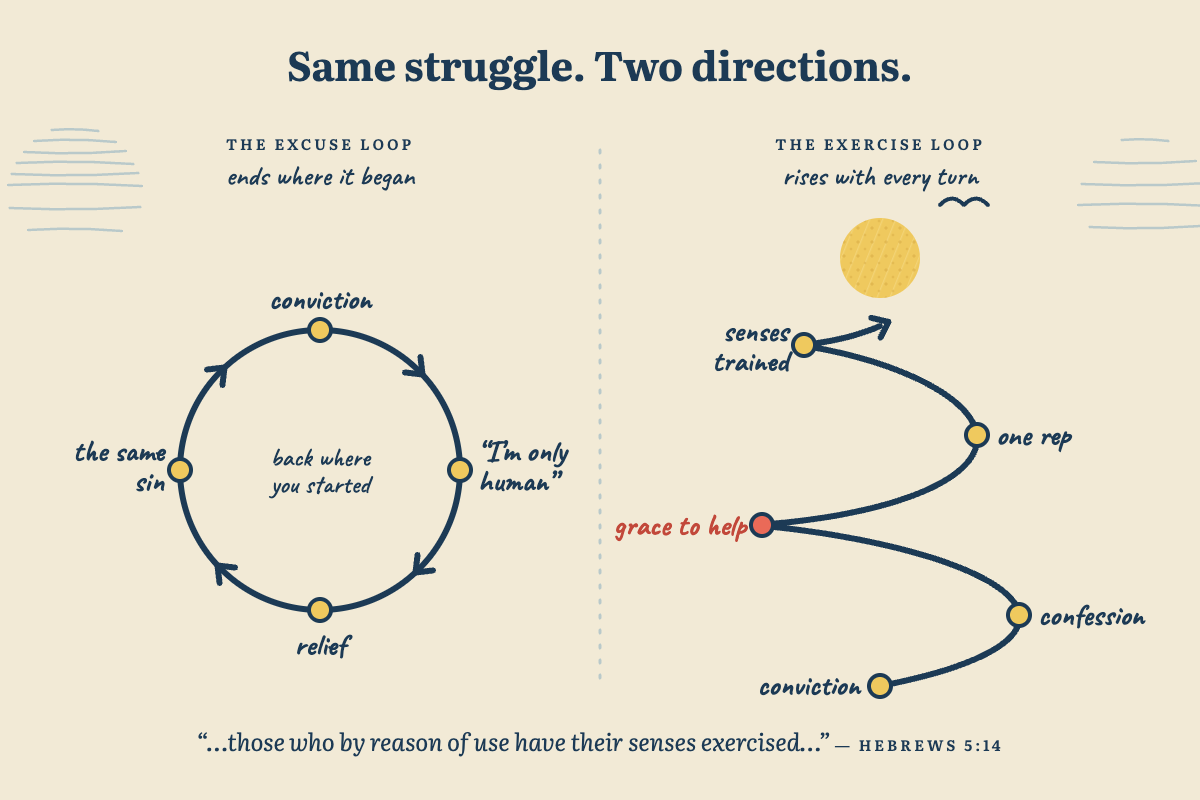
Finish the Sentence
You don’t have to stop saying it. You only have to finish it.
I’m only human, so I need Your Spirit, Lord, not my excuses.
Nobody’s perfect, so cleanse me, Lord, and make me more like Your Son.
God understands, so meet me at the throne of grace, Lord, and give me grace to help in my time of need of deliverance.
Guilt doesn't come from God, so speak the truth into me, Lord, and convict me of my sin so I can repent.
Pray those lines today, out loud if you can. Then pick the one room where the excuse has lived longest, and take one step against it today. A race doesn’t begin with a grand vow; it begins with the first stride.
Three words once talked over the Holy Spirit. Half a sentence kept you small. Let conviction finish its sentence, and finish yours with it.